
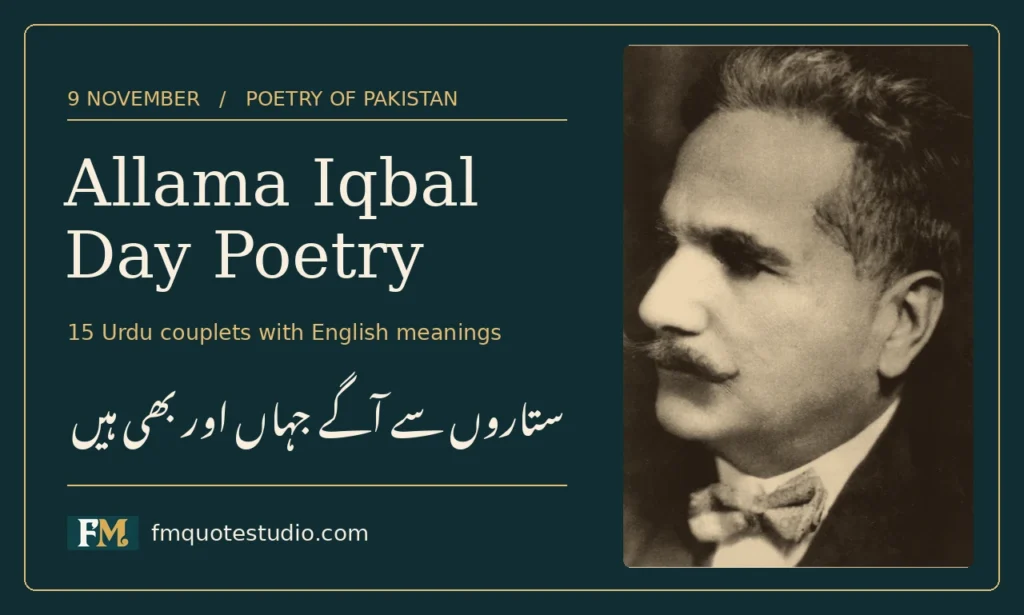
Iqbal Day poetry gives us a way to remember Allama Muhammad Iqbal on 9 November. Start with his famous lines about worlds beyond the stars, or read Bache Ki Dua if you need a short Urdu verse for a school assembly. Below are 15 couplets with Roman Urdu and plain English meanings, plus 70 original tributes, speech openings, captions and messages.
Quick Answer
When is Iqbal Day? Pakistan observes Iqbal Day on 9 November, the birth anniversary of Allama Muhammad Iqbal, who was born in Sialkot in 1877. For a two-line recitation, start with Sitaron se aage jahan aur bhi hain from Bal-e-Jibril. For younger children, choose the opening of Bache Ki Dua. Pakistan’s Independence Day falls on 14 August.
Table of Contents
- 15 famous Urdu couplets with English meanings
- Original two-line English poetry
- Recitation lines for students and kids
- School speech and opening lines
- 9 November messages
- Short captions
- Pakistan Independence Day messages
- What Iqbal’s images mean
- When to use these verses
- Frequently asked questions
15 Famous Iqbal Day Poetry Couplets in Urdu and English
These verses are by Allama Iqbal. Each entry names the work it comes from, gives a Roman Urdu reading, and offers a short English rendering by FM Quote Studio. Some Urdu editions vary in punctuation and spelling. The text is also printed alongside every card so you can copy it or read it aloud.
Iqbal’s Ghazals on Ambition and Hope
In these ghazals, Iqbal looks past the familiar. A falcon suggests what we can do with freedom, and an apparently empty field asks how quickly we give up on potential.
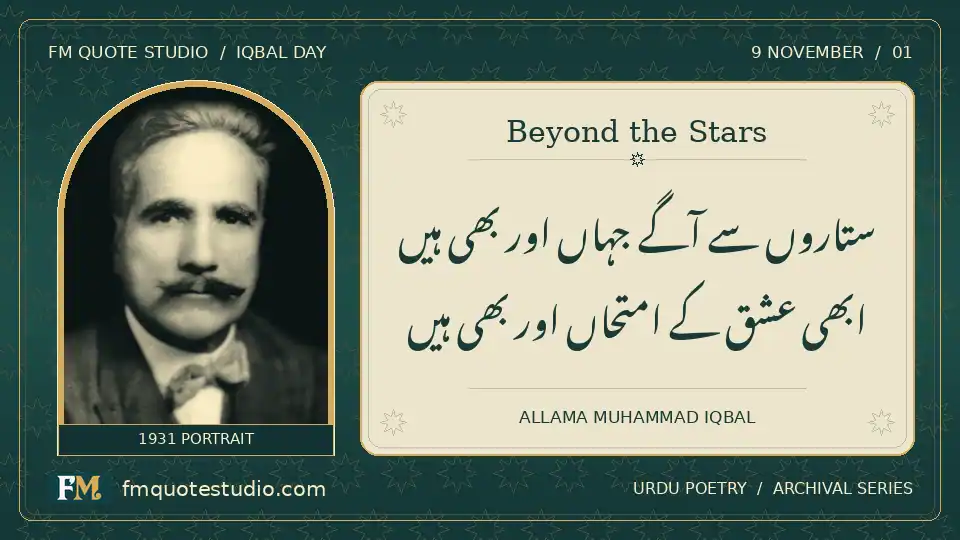
1. Beyond the Stars
Sitaron Se Aage Jahan Aur Bhi Hain · Bal-e-Jibril
ستاروں سے آگے جہاں اور بھی ہیں
ابھی عشق کے امتحاں اور بھی ہیں
Roman Urdu
Sitaron se aage jahan aur bhi hain
Abhi ishq ke imtihan aur bhi hain
English meaning
Beyond what you can see, there are more worlds to discover and more ways for devotion to be tested.
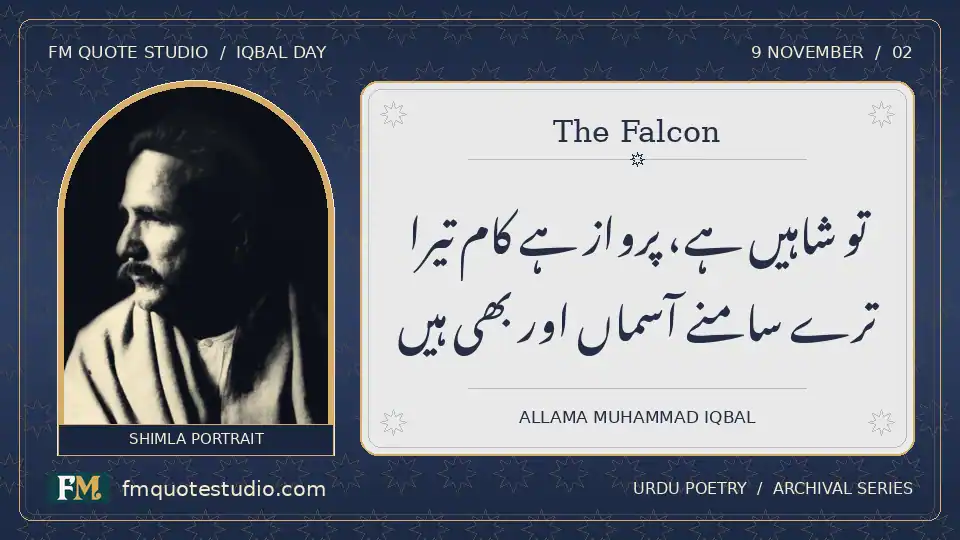
2. The Falcon
Sitaron Se Aage Jahan Aur Bhi Hain · Bal-e-Jibril
تو شاہیں ہے، پرواز ہے کام تیرا
ترے سامنے آسماں اور بھی ہیں
Roman Urdu
Tu shaheen hai, parwaz hai kaam tera
Tere samne aasman aur bhi hain
English meaning
You are a falcon, made to fly. There are other skies ahead of you.
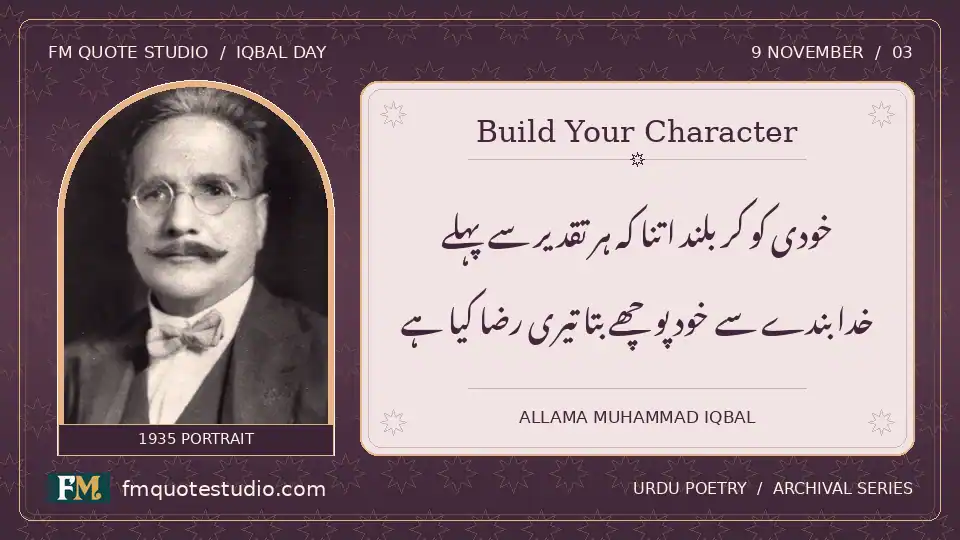
3. Build Your Character
Khirad Mandon Se Kya Poochun · Bal-e-Jibril
خودی کو کر بلند اتنا کہ ہر تقدیر سے پہلے
خدا بندے سے خود پوچھے بتا تیری رضا کیا ہے
Roman Urdu
Khudi ko kar buland itna ke har taqdeer se pehle
Khuda bande se khud poochhe, bata teri raza kya hai
English meaning
Develop your inner self so fully that, before destiny is set, God asks what you wish.
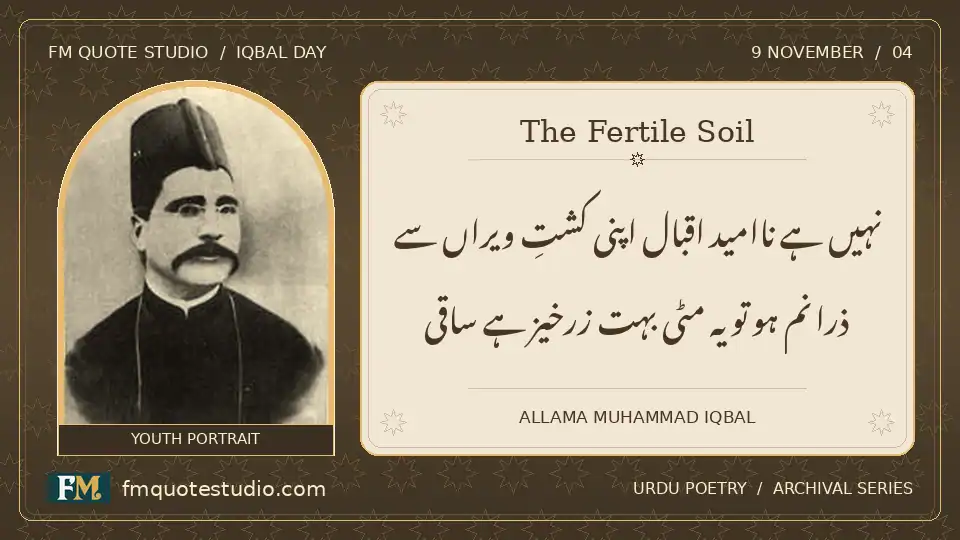
4. The Fertile Soil
Digar-gun Hai Jahan · Bal-e-Jibril
نہیں ہے ناامید اقبال اپنی کشتِ ویراں سے
ذرا نم ہو تو یہ مٹی بہت زرخیز ہے ساقی
Roman Urdu
Nahin hai na-umeed Iqbal apni kisht-e-veeran se
Zara nam ho to ye mitti bohat zarkhez hai, saqi
English meaning
Iqbal still has hope for his deserted field. With a little moisture, the soil can yield abundantly.
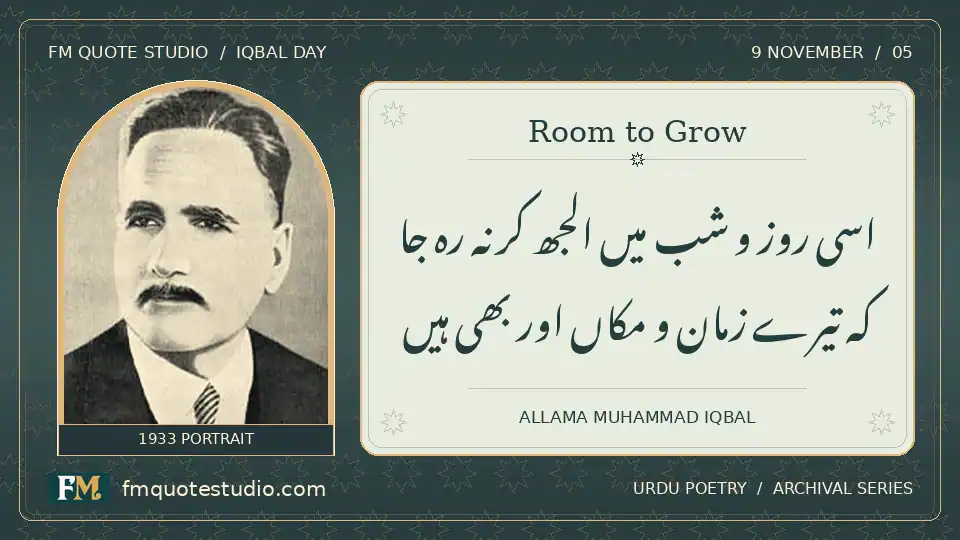
5. Room to Grow
Sitaron Se Aage Jahan Aur Bhi Hain · Bal-e-Jibril
اسی روز و شب میں الجھ کر نہ رہ جا
کہ تیرے زمان و مکاں اور بھی ہیں
Roman Urdu
Isi roz-o-shab mein ulajh kar na reh ja
Ke tere zaman-o-makan aur bhi hain
English meaning
Do not get tangled in the same round of days and nights. Other times and places await you.
For a journal entry on starting again, pair the image of the field with these quotes about hope.
Bache Ki Dua for a School Assembly
The speaker of Bache Ki Dua is a child asking to learn, to do good and to become useful to others. Its familiar opening works well as a group recitation. The later couplets give individual students something specific to reflect on.
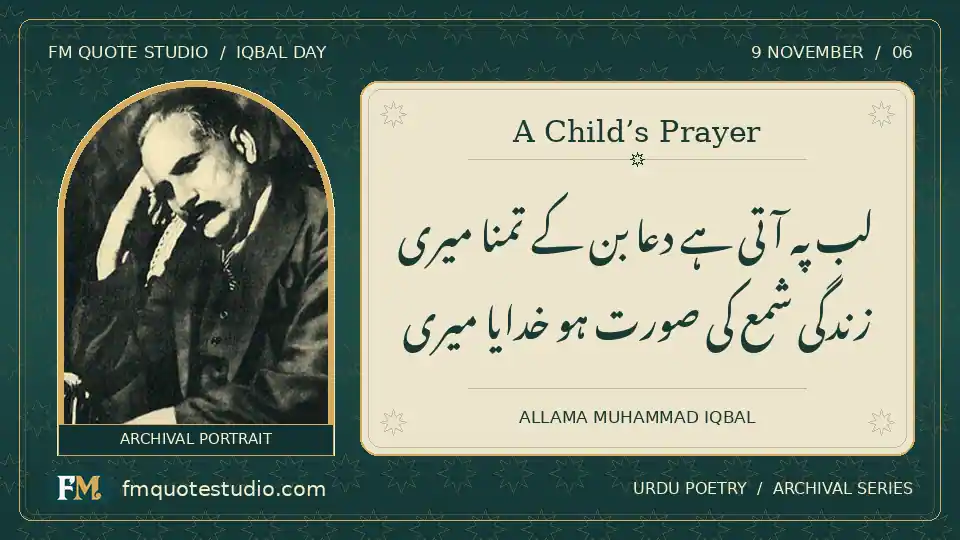
6. A Child’s Prayer
Bache Ki Dua · Bang-e-Dara
لب پہ آتی ہے دعا بن کے تمنا میری
زندگی شمع کی صورت ہو خدایا میری
Roman Urdu
Lab pe aati hai dua ban ke tamanna meri
Zindagi shama ki surat ho, Khudaya, meri
English meaning
My wish comes to my lips as a prayer. God, let my life shine like a candle.
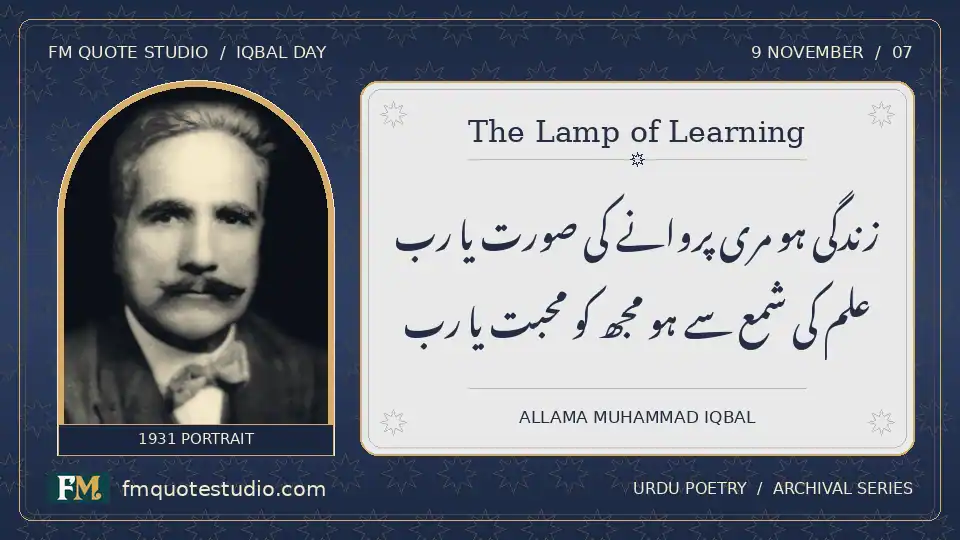
7. The Lamp of Learning
Bache Ki Dua · Bang-e-Dara
زندگی ہو مری پروانے کی صورت یا رب
علم کی شمع سے ہو مجھ کو محبت یا رب
Roman Urdu
Zindagi ho meri parwane ki surat, ya Rab
Ilm ki shama se ho mujh ko mohabbat, ya Rab
English meaning
Lord, let me be drawn to the light of knowledge as a moth is drawn to a flame.
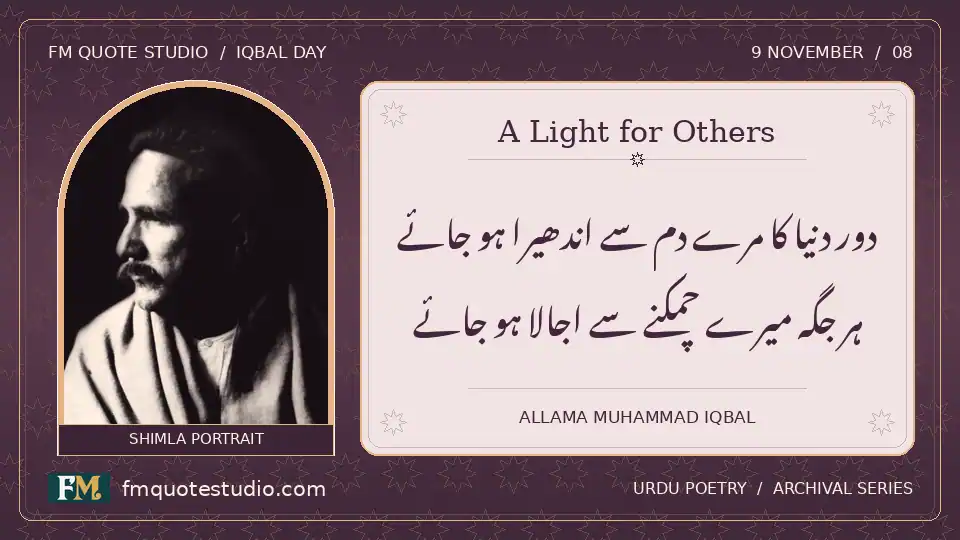
8. A Light for Others
Bache Ki Dua · Bang-e-Dara
دور دنیا کا مرے دم سے اندھیرا ہو جائے
ہر جگہ میرے چمکنے سے اجالا ہو جائے
Roman Urdu
Door duniya ka mere dam se andhera ho jaye
Har jagah mere chamakne se ujala ho jaye
English meaning
May the light I give help drive out darkness and brighten the places I reach.
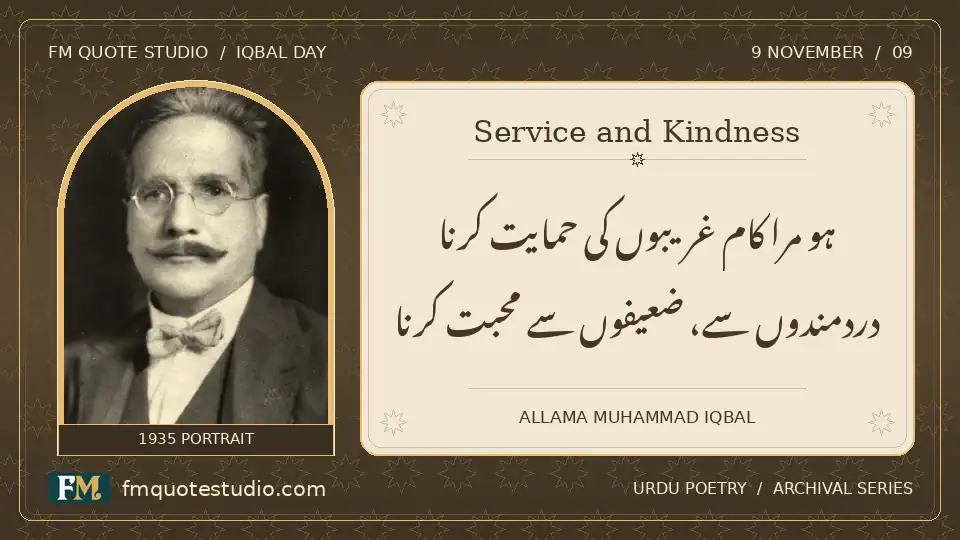
9. Service and Kindness
Bache Ki Dua · Bang-e-Dara
ہو مرا کام غریبوں کی حمایت کرنا
دردمندوں سے، ضعیفوں سے محبت کرنا
Roman Urdu
Ho mera kaam ghareebon ki himayat karna
Dardmandon se, zaeefon se mohabbat karna
English meaning
May my work be to stand with the poor and care for people who suffer or lack strength.
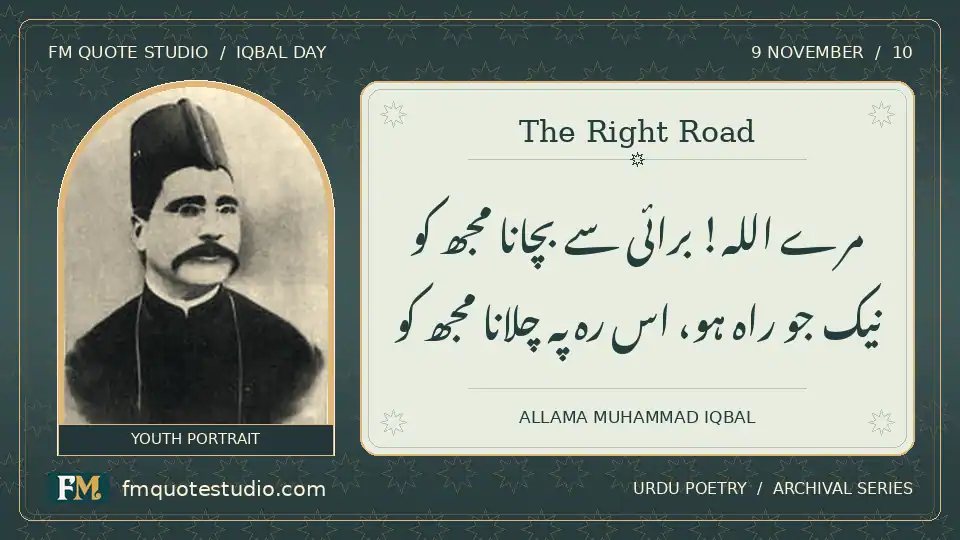
10. The Right Road
Bache Ki Dua · Bang-e-Dara
مرے اللہ! برائی سے بچانا مجھ کو
نیک جو راہ ہو، اس رہ پہ چلانا مجھ کو
Roman Urdu
Mere Allah, burai se bachana mujh ko
Nek jo raah ho, us rah pe chalana mujh ko
English meaning
God, keep me from wrongdoing and guide my feet toward the good path.
Famous Lines on Sincerity, Action and Belonging
These selections come from a mix of longer poems and ghazals. Tarana-e-Hindi refers to the shared homeland of pre-Partition India. Read it in that historical setting when discussing Iqbal’s ideas about fellowship.
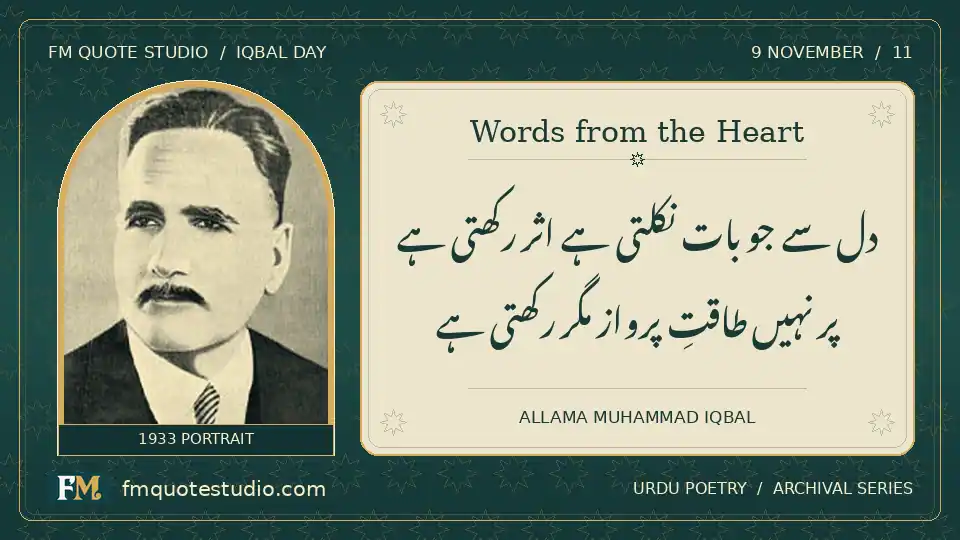
11. Words from the Heart
Jawab-e-Shikwa · Bang-e-Dara
دل سے جو بات نکلتی ہے اثر رکھتی ہے
پر نہیں طاقتِ پرواز مگر رکھتی ہے
Roman Urdu
Dil se jo baat nikalti hai asar rakhti hai
Par nahin, taqat-e-parwaz magar rakhti hai
English meaning
Words that come from the heart carry influence. They have no wings, yet they can fly.
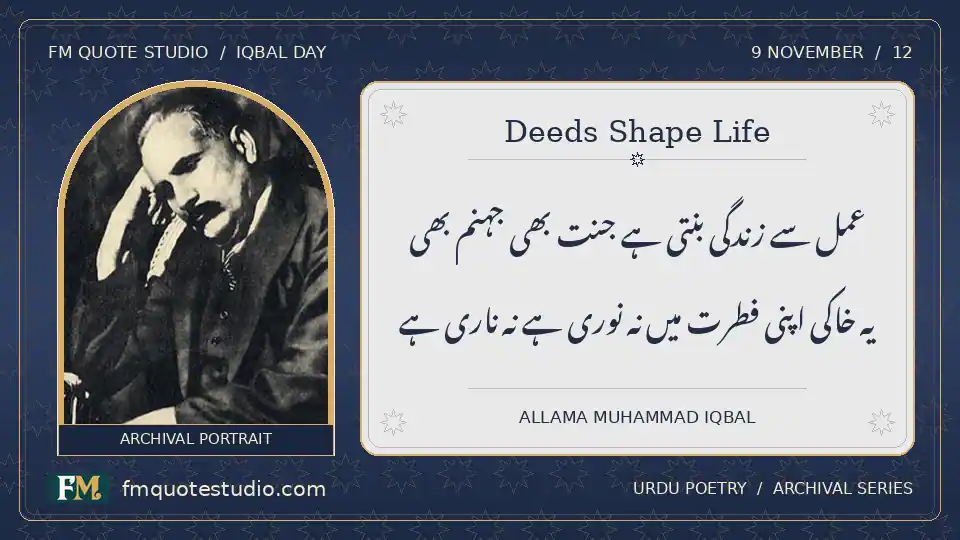
12. Deeds Shape Life
Tulu-e-Islam · Bang-e-Dara
عمل سے زندگی بنتی ہے جنت بھی جہنم بھی
یہ خاکی اپنی فطرت میں نہ نوری ہے نہ ناری ہے
Roman Urdu
Amal se zindagi banti hai jannat bhi jahannam bhi
Ye khaki apni fitrat mein na noori hai na nari hai
English meaning
Our actions can turn life into heaven or hell. Human beings, made of dust, begin as neither pure light nor pure fire.
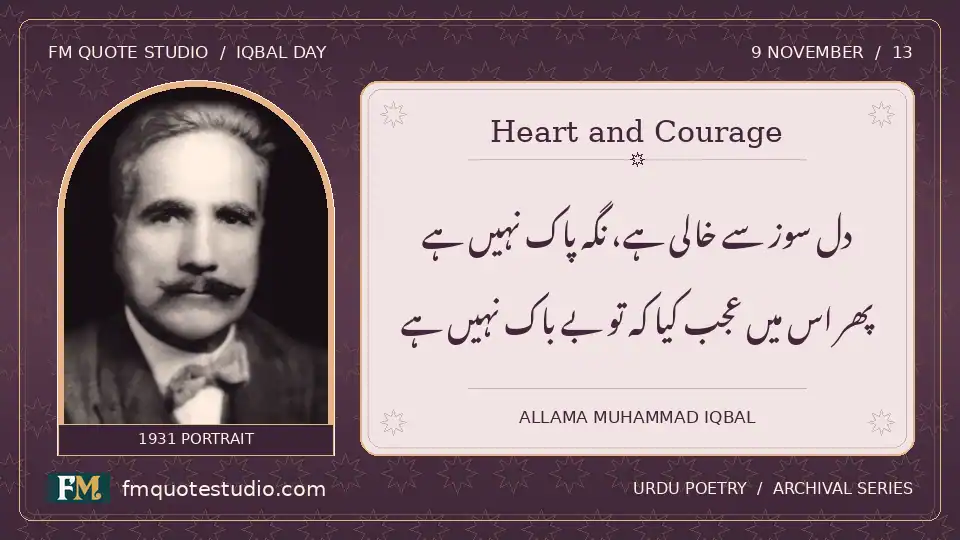
13. Heart and Courage
Dil Soz Se Khali Hai · Bal-e-Jibril
دل سوز سے خالی ہے، نگہ پاک نہیں ہے
پھر اس میں عجب کیا کہ تو بے باک نہیں ہے
Roman Urdu
Dil soz se khali hai, nigah pak nahin hai
Phir is mein ajab kya ke tu bebak nahin hai
English meaning
When the heart lacks passion and the gaze lacks purity, it is hardly surprising that courage is missing.
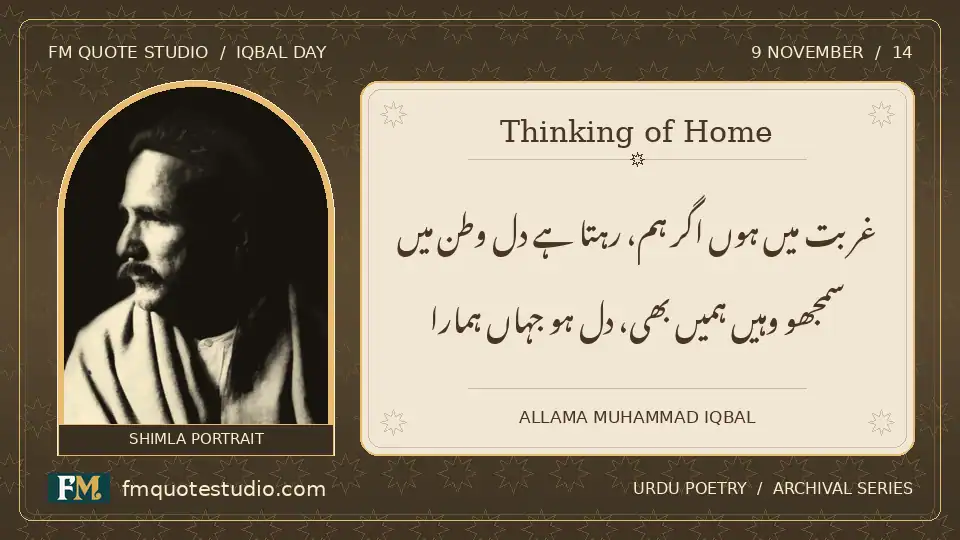
14. Thinking of Home
Tarana-e-Hindi · Bang-e-Dara
غربت میں ہوں اگر ہم، رہتا ہے دل وطن میں
سمجھو وہیں ہمیں بھی، دل ہو جہاں ہمارا
Roman Urdu
Ghurbat mein hon agar hum, rehta hai dil watan mein
Samjho wahin hamein bhi, dil ho jahan hamara
English meaning
Even when we are far from home, our hearts remain there. Think of us as present where our hearts are.
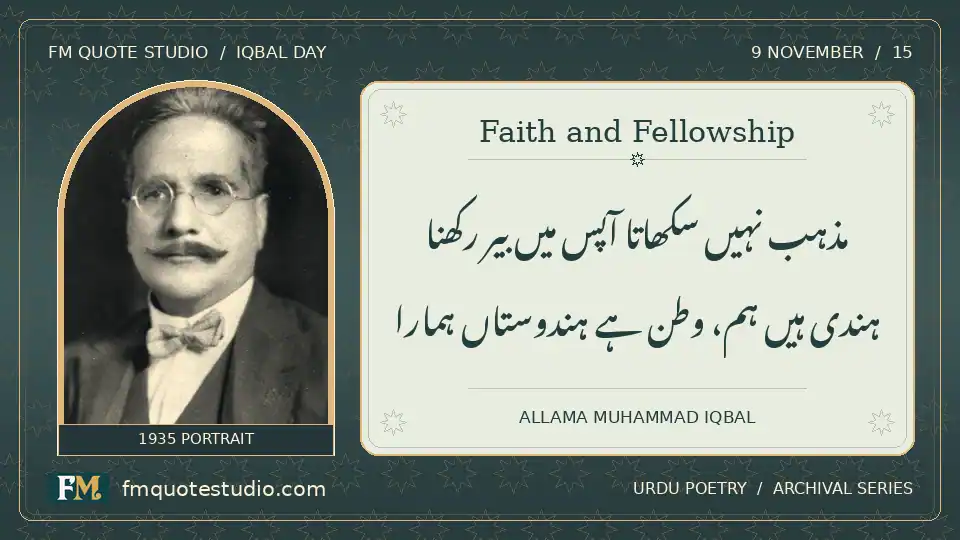
15. Faith and Fellowship
Tarana-e-Hindi · Bang-e-Dara
مذہب نہیں سکھاتا آپس میں بیر رکھنا
ہندی ہیں ہم، وطن ہے ہندوستاں ہمارا
Roman Urdu
Mazhab nahin sikhata aapas mein bair rakhna
Hindi hain hum, watan hai Hindostan hamara
English meaning
Faith does not teach us to hold grudges against one another. We belong to Hindustan, our homeland.
Photographs of Allama Muhammad Iqbal via Wikimedia Commons. The cards use his youth, Shimla, 1931, 1933 and 1935 portraits, along with an archival seated portrait. The cover uses the Iqbal Academy Pakistan photograph.
10 Original Two-Line Iqbal Day Tributes
These English couplets are original tributes inspired by themes in Iqbal’s work. Read one after an authentic Urdu verse, or use it as the closing line on a 9 November poster.
- The stars we counted on the roof
Were never meant to be the whole sky. - At dawn the bird leaves half a branch behind
And takes the morning with it. - A candle has a small room to light
And spends its whole life doing it. - The page still carries yesterday’s eraser marks
Leave room beneath them for a better answer. - The field looks empty from the road
The rain knows what the soil remembers. - Let the brave thing be a quiet thing
A hand raised when the whole room turns away. - I went to ask the dark for directions
My little lamp had already chosen a road. - The sky was there before I learned to fly
The first wingbeat was still mine to give. - If I am given one line to write today
Let someone else find a door in it. - We came to hear a poet from the past
And found our own unfinished work.
10 English Recitation Lines for Students and Children
For a morning assembly, give each student one couplet. Younger readers can pause after the first line and look up before finishing the second.
- My book is open on my knee
And every page has room for me. - I learned a word and said it twice
Then helped my friend pronounce it right. - When I get stuck, I’ll take my time
Even little feet can learn to climb. - If someone has no seat today
I’ll move my bag out of the way. - Dear God, when someone feels alone
Help me make a place beside my own. - I drew a bird beside my name
Tomorrow I will draw it out of its cage. - If I can help before the bell
I have one good thing I can tell. - Some days my courage sounds like this
“Sir, could you please explain what I missed?” - The tallest tree beside our gate
Was once a seed that had to wait. - I wish to learn with open eyes
And see what helps the people by my side.
If a pupil feels nervous before speaking, read one of these short quotes about courage and fear together before rehearsal.
10 Iqbal Day Speech Openings
These original openings give a speaker a concrete place to begin. Follow the opening with one attributed couplet and a detail from your own school or community.
A One-Minute Iqbal Day Speech in English
Good morning, teachers and friends. Today, on 9 November, we remember Allama Muhammad Iqbal. In Bache Ki Dua, a child asks God for a life like a candle. I like that picture because a candle helps everyone around it see a little better.
When a classmate misses a lesson, we can share our notes. When someone sits alone, we can make room for them. These are small things we can do before the day is over. As we listen to Iqbal’s poetry today, I hope each of us finds one good thing we can do with what we learn. Thank you.
- Look at the hands around this room. Any one of them could help someone learn before the day is over.
- The first Iqbal verse I remember is a prayer. Its speaker asks to become a light other people can see by.
- Think of one time you stayed quiet because you were afraid of giving the wrong answer. Keep that moment in mind as we listen to Iqbal’s falcon.
- If you grew up hearing a poem in Urdu, you may remember its sound years before you understand every word.
- We can celebrate a poet by saying his name. Today I want to spend a minute on what one of his lines asks me to do.
- A field at the end of a dry summer is an unlikely place to look for hope. Iqbal looks there anyway.
- I want to start with the smallest word in my speech. In Urdu, amal means action.
- When I first heard about worlds beyond the stars, I pictured planets. Now I also picture the choices I had been too afraid to imagine.
- Imagine a lamp on a classroom desk after everyone goes home. What might change if we let its light reach the desk beside it?
- Here is a question I would like us to carry out of this hall. Who can read a little better because we shared what we learned?
10 Messages for 9 November
Send these original messages to a teacher, class group, or relative. A personal detail about who first taught you a poem makes the greeting feel like yours.
- Happy Iqbal Day. May we pass along one piece of what we learn today.
- This 9 November, I’m thinking of the teacher who made us read past the first line of the poem.
- Wishing you an Iqbal Day with a good book, an unhurried conversation and a little courage for what comes next.
- Happy Iqbal Day to every student who asked a question even when their voice shook.
- May your children inherit the poems you love and the freedom to ask what they mean.
- For everyone reading Iqbal far from Pakistan, I hope a familiar verse makes home feel closer today.
- On Iqbal Day, thank you to the teachers who notice the child sitting quietly at the back.
- May we bring the patience we admire in a poem to the people who need it at home.
- Remembering Iqbal today with a wish that our learning makes us kinder to the people within reach.
- Happy Iqbal Day. I hope you get a chance to read a verse aloud with someone who remembers it too.
10 Short Iqbal Day Captions
These original captions work with a poetry card, a school photo or a video of a recitation. Keep the poet’s credit visible when posting one of his couplets.
- A candle in a classroom. An idea for a lifetime.
- 9 November, with Iqbal on the reading list.
- The falcon has a wide sky and work to do.
- One couplet before the morning bell.
- A little rain for the field we nearly gave up on.
- My grandfather’s Urdu, in my voice today.
- The edge of the notebook is a good place to draw a bigger sky.
- Recited in Urdu. Carried home in our own words.
- A verse from the shelf, a question for the walk home.
- Reading the stars with both feet in the schoolyard.
To pair your verse with a class photo, see our guide to writing a good photo caption.
10 Original Messages for Pakistan’s Independence Day
Pakistan marks Independence Day on 14 August. These messages are written for that occasion and draw on themes of learning, service and belonging found in Iqbal’s work.
- May the flag we raise in the morning remind us to hold open a door for someone by evening.
- Happy Independence Day, Pakistan. May every child who wants to learn have a desk to sit at.
- From our family abroad to everyone back home, may your 14 August be warm with company and safe on the road.
- Here’s to the people who stay after the celebration to sweep the schoolyard.
- May the next generation know our country through the neighbors who cared for them as much as through the dates they memorized.
- A happy 14 August to the teachers who help young people imagine a future they can take part in.
- This Independence Day, tell a child one true story about the street where you grew up.
- May we carry the same pride into a hard day’s work that we feel when the flag goes up.
- May our idea of belonging reach the family that just moved in and the neighbor whose prayers sound different from ours.
- When the bunting comes down, may we still remember the promise we made to each other beneath it.
10 Original Lines About Khudi, Hope and Action
These original reflections are for journals, debate prompts and class discussions. Choose one you can connect to a decision you faced this week.
- Character is the decision you can still respect after the room has emptied.
- A garden recovers one watered patch at a time.
- The first use of something you learn could be explaining it to the person who missed class.
- Ask what your ambition would look like if another person could benefit from it.
- Hope can be as ordinary as returning the next day with a sharper pencil.
- Some courage arrives as the apology you have practiced on the way to someone’s door.
- Before you call a field barren, find out when it last had rain.
- The work of becoming yourself includes deciding which applause you can live without.
- A sentence you believe sounds different when you have acted on it.
- The day’s good deed might be small enough to fit between two bus stops.
What Iqbal’s Poetry Means
Khudi is often explained as the self or selfhood. In the couplet about raising it, Iqbal places self-development in a relationship with God. For a class discussion, ask what strength of character looks like when there is no reward in sight. These quotes about strength offer another starting point.
Shaheen is the falcon. Put it beside the image of the stars and the sky becomes an invitation to move. Ask students to name a skill they once thought was beyond them and the person who helped them try.
The candle and the soil offer two smaller pictures. In the child’s prayer, light is something to share. In the barren-field couplet, rain stands for a condition that can help dormant potential grow. A patient teacher, regular practice or a second chance can be that change.
When to Use These Verses
- School assembly — Read the Urdu couplet first, then give its English meaning in one sentence. Let a second student offer a real example.
- WhatsApp status or a 9 November poster — Use one card with a short caption. Keep the poet’s name visible and include the verse as text if the platform supports it.
- Class discussion — Put the falcon and the candle side by side. Ask what each image says about ambition and service.
- Pakistan Independence Day — Use one of the original 14 August messages, or select an Iqbal verse about learning or action and name the work it comes from.
- Family reading — Ask someone older which line they heard at school. Read it aloud together and compare what it meant to each of you.
Related Quotes and Reading
- Good morning inspirational quotes for an assembly opening
- Short quotes about turning intentions into daily habits
Frequently Asked Questions
Why is Iqbal Day on 9 November?
It marks the birth anniversary of Allama Muhammad Iqbal, who was born on 9 November 1877 in Sialkot.
What is a famous two-line verse for Iqbal Day?
Choose the opening of the ghazal Sitaron Se Aage Jahan Aur Bhi Hain from Bal-e-Jibril. The first card gives both lines in Urdu, Roman Urdu and English.
Which Iqbal poem is best for children to recite?
Bache Ki Dua is a good starting point. Its opening candle image is easy to picture and short enough for a young child to learn.
What does Khudi ko kar buland mean?
It calls on the reader to cultivate the self through inner strength and spiritual growth. The couplet imagines a person whose developed self has a say in what lies ahead.
What does the shaheen symbolize in Iqbal’s poetry?
The shaheen, or falcon, suggests courage, freedom and a readiness to act. In the ghazal here, there are always more skies before it.
How do I open an English speech with Urdu poetry?
Greet the audience, introduce Iqbal and the occasion, then recite one short Urdu couplet. Give its English meaning before you explain why you chose it.
Are the English tributes quotations from Iqbal?
The items labeled original are new writing by FM Quote Studio. Each authentic Urdu couplet separately names its source and has an English rendering.
What is the difference between Iqbal Day and Independence Day?
Iqbal Day marks the poet’s birth anniversary on 9 November. Pakistan’s Independence Day is celebrated on 14 August.
Are these verses ghazals or nazms?
The collection includes both. Sitaron Se Aage is a ghazal, whose couplets can often be read individually. Bache Ki Dua is a nazm with a single continuous subject, a child’s prayer.
What can I write on an Iqbal Day poster?
Write “Iqbal Day • 9 November,” include one short verse, and credit Allama Muhammad Iqbal. The falcon couplet is a good choice for a student poster.
Read more about the poet’s life and published works in the Wikipedia biography of Muhammad Iqbal.